
Affiliate Disclosure: VPNexp.com is reader-supported. We may earn a commission if you purchase a VPN through links on our site. This does not affect our rankings or recommendations.
NordVPN vs ExpressVPN (2026)
NordVPN and ExpressVPN are two of the most respected VPN brands on the planet. Both are fast. Both are secure. Both unblock streaming. And both have built reputations around privacy. So why does this comparison still matter in 2026? Because these two VPNs are optimized for different kinds of people. NordVPN has evolved into a feature-rich, performance-focused “best overall” pick with strong long-term value. ExpressVPN has doubled down on the smoothest, simplest “it just works” experience—often at a higher price. This guide breaks down what’s actually different (and what’s not), so you can pick the VPN you’ll be happy using every day.
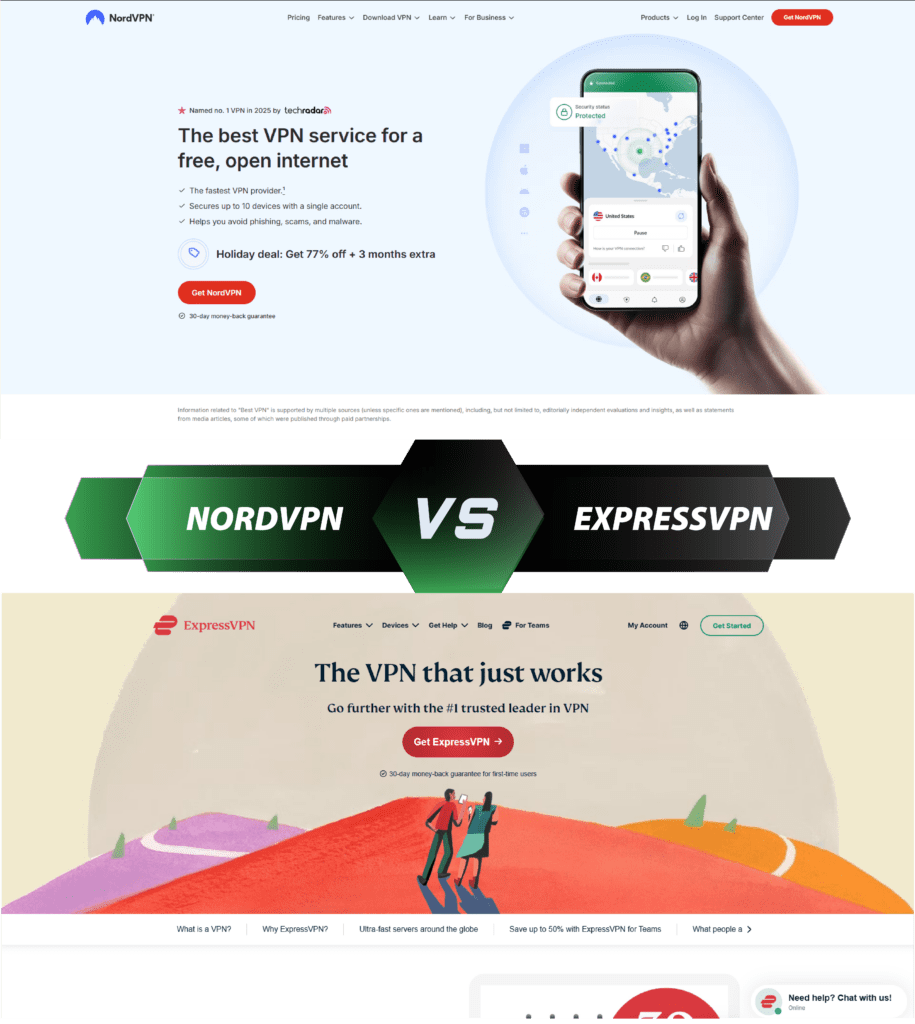
Table of Contents
- Quick Verdict (TL;DR)
- What You’re Really Buying (and why these two feel different)
- Privacy & Logging: Who’s more trustworthy?
- Security Features: Tools, protocols, and leak protection
- Speed & Performance: Downloads, gaming, and long-distance
- Streaming: Netflix and friends in 2026
- Torrenting & P2P: What actually matters
- Apps & Ease of Use: The daily experience
- Pricing & Value: The real cost of “premium”
- Which one should you choose? (Common scenarios)
- Quick FAQ
- Final Verdict
Quick Verdict (TL;DR)
NordVPN is the better VPN for most people in 2026. It’s typically faster and more consistent, offers a deeper security/toolkit, and delivers stronger long-term value—especially if you’re buying a VPN to use daily for streaming, privacy, and travel.
ExpressVPN is still an elite VPN and arguably the smoothest “it just works” experience. But it’s usually harder to justify on price unless you care most about simplicity, stable connections on the move, and minimal settings.
| Category | NordVPN | ExpressVPN | VPNexp winner |
|---|---|---|---|
| Privacy confidence | Strong audits + Panama jurisdiction | Strong audits + RAM-only infra | NordVPN |
| Security toolkit | More features + more control | Fewer toggles, great defaults | NordVPN |
| Speed consistency | Excellent across regions | Very good, strong stability | NordVPN |
| Streaming reliability | Excellent | Excellent | Tie |
| Ease of use | Easy + advanced options | Best-in-class simplicity | ExpressVPN |
| Value | Typically much better | Premium-priced | NordVPN |
What You’re Really Buying (and why these two feel different)
Most VPN comparisons obsess over the same surface checklist: “Does it have AES-256? Does it have a kill switch? Does it have a no-logs policy?” In 2026, those are table stakes. The real difference is the experience: how quickly you connect, how often you notice slowdowns, how often streaming breaks, how much you have to fiddle with settings, and how confident you feel that the company can back its privacy claims when it matters.
Think of NordVPN as the “high-performance Swiss Army knife.” You get excellent speeds, a strong privacy posture, a deep feature set, and pricing that often feels like a deal for what you’re getting. It’s the VPN you pick when you want the best overall package and you don’t mind having a few extra options under the hood.
Think of ExpressVPN as the “premium sedan.” It’s smooth, stable, and intentionally minimal. For many people—especially non-technical users—that simplicity is a feature. You pay more, but you get a product that’s designed to feel frictionless, particularly on mobile and when moving between networks.
If you want the shortest decision rule: pick NordVPN if you want the best overall mix of speed, features, and value. Pick ExpressVPN if you want the simplest premium experience and you’re okay paying extra for it.
Privacy & Logging: Who’s More Trustworthy?
A VPN is a trust product. You’re choosing a company to sit between you and the internet. That means the most important questions are: what data could they collect, what do they say they collect, and how much independent verification exists that their policies match reality?
NordVPN: Panama jurisdiction + repeat verification
NordVPN is headquartered in Panama, a jurisdiction that’s generally viewed as privacy-friendly for VPN operations. Jurisdiction isn’t a magic shield—technical design matters more—but it can reduce the likelihood of aggressive data retention or overbroad reporting requirements. NordVPN’s bigger strength is that it has spent years building a privacy track record backed by independent audits and operational transparency.
In practical terms, NordVPN’s privacy posture is designed around limiting what’s stored and making it difficult to tie activity back to an individual user. For everyday buyers, this matters because it lowers the “trust burden.” You’re not just accepting a marketing claim—you’re leaning on a pattern of third-party verification.
ExpressVPN: privacy engineering + “minimal data by design”
ExpressVPN has long been known for privacy-first positioning, and it backs that up with infrastructure choices like RAM-only servers (diskless design). The advantage is straightforward: if servers don’t store data on persistent disks, there’s less to seize, less to leak, and less that can linger longer than intended. ExpressVPN has also undergone audits that focus on infrastructure and security controls.
Where ExpressVPN differs from NordVPN is not that it’s “less private,” but that it leans more heavily on engineering simplicity: fewer complex features, fewer modes, fewer ways users can misconfigure things. It’s a “safe default” philosophy.
| Privacy factor | NordVPN | ExpressVPN | Edge |
|---|---|---|---|
| Jurisdiction perception | Panama | Varies by structure | NordVPN |
| Audit track record | Strong and repeat | Strong | NordVPN |
| Infrastructure privacy | Strong | RAM-only emphasis | ExpressVPN |
| “Set-and-forget” trust | High | Very high | Tie |
Privacy verdict: Both are strong choices, but NordVPN gets a slight edge for most people thanks to jurisdiction + repeat audit confidence. If you specifically value “minimal data by design,” ExpressVPN’s infrastructure story is compelling.
Security Features: Tools, Protocols, and Leak Protection
Security is not just encryption. It’s also DNS behavior, leak prevention, protocol quality, how the kill switch behaves under stress, and whether the product helps protect you from common real-world threats (phishing, malware domains, trackers). In 2026, both NordVPN and ExpressVPN cover the essentials. The differences are in depth and control.
Protocols: NordLynx vs Lightway
NordVPN’s NordLynx is a WireGuard-based implementation designed for speed and efficiency. ExpressVPN’s Lightway is its proprietary protocol focused on stability and fast reconnections (which matters more than you’d think on mobile). Both are modern and secure; most users should default to the provider’s “recommended” setting and only switch if they’re troubleshooting.
Kill switch and leak protection
A kill switch is the difference between “VPN on” and “VPN actually protecting you.” If your connection drops for even a few seconds without a kill switch, apps can fall back to your normal connection and expose your real IP. Both NordVPN and ExpressVPN have kill switches, but NordVPN typically provides more granularity and options, while ExpressVPN aims for dependable defaults that require minimal thought.
| Security feature | NordVPN | ExpressVPN | Practical impact |
|---|---|---|---|
| Kill switch | Yes (often more controls) | Yes (very simple) | Prevents IP leaks on drops |
| Threat/tracker blocking | Strong suite | More limited | Less tracking, fewer bad domains |
| Obfuscation | Available | Limited/varies | Helps on restrictive networks |
| Double-routing options | Available | Not a focus | More privacy, usually slower |
One important reminder: VPN “extra” features can be useful, but they can also confuse users. ExpressVPN’s approach shines here—it’s hard to misconfigure. NordVPN’s approach shines if you want more control, or if you’re the kind of user who runs into edge cases: restrictive Wi-Fi, long-distance travel, heavy streaming, torrenting, or privacy-maximized setups.
Security verdict: Both are secure. NordVPN wins for most people because it offers more protective tools and controls without being difficult to use.
Speed & Performance: Downloads, Gaming, and Long-Distance
Speed is the #1 reason people stop using a VPN. Not because the VPN is “bad,” but because the day-to-day friction adds up: streaming buffers, video calls stutter, downloads crawl, and websites feel sluggish. The best VPN is the one you can leave on without noticing it.
In 2026, both NordVPN and ExpressVPN are fast. The distinction is that NordVPN often feels more consistently fast across regions and distances, especially with NordLynx. ExpressVPN is strong on stability—particularly on mobile and on network changes—but may not always match NordVPN’s peak throughput on long-distance routes.
What “speed” means in real life
Speed is not one number. It’s a mix of (1) download throughput, (2) upload throughput, and (3) latency (ping). If you stream or download, throughput matters. If you game, do video calls, or remote work, latency matters more. NordVPN tends to score well across all three, while ExpressVPN’s strength is often the “smoothness” of the connection—fast reconnects, fewer hiccups on the move, and stable performance when switching between Wi-Fi and mobile networks.
| Use case | What matters most | NordVPN | ExpressVPN | Edge |
|---|---|---|---|---|
| 4K streaming | Steady throughput | Excellent | Excellent | Tie |
| Large downloads | Peak speed | Often stronger | Very good | NordVPN |
| Gaming | Low latency | Strong on nearby servers | Strong stability | NordVPN |
| Travel / switching networks | Fast reconnect | Very good | Often excellent | ExpressVPN |
| Long-distance connections | Consistency | Often better | Very good | NordVPN |
Speed verdict: NordVPN wins for most people due to consistently strong performance, especially across distances. ExpressVPN is a great “stability” pick if you’re constantly switching networks.
Streaming: Netflix and Friends in 2026
Streaming is still the biggest reason people buy VPNs—and still the most fragile feature because streaming platforms constantly try to block VPN traffic. A VPN can be “great” for privacy and still be annoying for streaming if you have to server-hop every time you open an app.
In 2026, both NordVPN and ExpressVPN are among the most reliable streaming VPNs. Most users will be able to watch Netflix, Disney+, Prime Video, Hulu, and BBC iPlayer with minimal issues. If something fails, switching servers typically fixes it.
How to think about streaming reliability
There are two dimensions: “Does it work at all?” and “How often do I have to troubleshoot?” ExpressVPN’s brand has long been built around “just works,” and it still performs well here. NordVPN is also excellent and often provides more flexibility because of its broader feature set and server options. In practice, both are strong; differences show up most when a platform is actively cracking down in a specific region.
Streaming verdict: Tie. Both NordVPN and ExpressVPN are top-tier streaming choices in 2026.
Torrenting & P2P: What Actually Matters
For torrenting, the VPN requirements are simple: fast speeds, stable connections, a reliable kill switch, and a provider that allows P2P traffic. Both NordVPN and ExpressVPN meet those requirements. The main difference is operational style: NordVPN often uses P2P-optimized servers, while ExpressVPN generally keeps things simpler—connect and go.
If you torrent regularly, pay extra attention to the kill switch behavior. The kill switch is the real safety feature here. Without it, a momentary drop can expose your real IP. Both VPNs offer kill switches, but NordVPN often provides more control and configuration, while ExpressVPN aims for a clean default implementation.
Torrenting verdict: Tie. Pick NordVPN if you want more controls; pick ExpressVPN if you want the simplest P2P experience.
Apps & Ease of Use: The Daily Experience
This is where ExpressVPN earns its reputation. Its apps are minimal, consistent, and very hard to mess up. If you’re buying a VPN for a parent, a non-technical spouse, or a “I never want to think about this” person, ExpressVPN’s design is a real advantage.
NordVPN’s apps are also very user-friendly, but they expose more options: more toggles, more features, more “power user” pathways. For most people, that’s a plus—not a downside—because you can keep it simple, but you also have tools available when you need them (like obfuscation, threat blocking, and special routing modes).
| Daily-life factor | NordVPN | ExpressVPN | Edge |
|---|---|---|---|
| One-click simplicity | Very good | Excellent | ExpressVPN |
| Advanced controls | Excellent | Limited | NordVPN |
| Mobile network switching | Very good | Often excellent | ExpressVPN |
| Set-and-forget usage | Excellent | Excellent | Tie |
Apps verdict: ExpressVPN wins on pure simplicity. NordVPN wins if you want flexibility without losing ease-of-use.
Pricing & Value: The Real Cost of “Premium”
Pricing is where the NordVPN vs ExpressVPN conversation usually gets decided. ExpressVPN is frequently one of the most expensive consumer VPNs available. NordVPN is also premium, but long-term plans are often priced far more competitively—especially relative to the performance and feature set you get.
The key question isn’t “Is ExpressVPN good?” It is. The question is: is ExpressVPN worth paying more for? For a subset of users—especially those who value maximum simplicity and stability—the answer can be yes. For most buyers, NordVPN offers a better return: excellent speeds, rich security tools, and strong reliability for noticeably less money on long-term plans.
One practical way to think about it: most people buy a VPN hoping they’ll keep it on most of the time. If you’re turning your VPN into a daily habit, the long-term plan price matters. NordVPN’s long-term pricing often makes it easier to commit to that habit without feeling like you’re paying a “luxury tax.”
Value verdict: NordVPN wins decisively for most people. ExpressVPN’s price is best justified if you’re buying the simplest, most frictionless experience.
Which One Should You Choose? (Common Scenarios)
If you’re still stuck, decide based on your primary use case. Here’s the practical guidance most people actually need—without overthinking it.
Choose NordVPN if you:
- want the best overall mix of speed, security, and value
- stream a lot and want excellent reliability with flexibility
- want protective extras like threat/tracker blocking
- care about long-term pricing (and you should)
- sometimes need advanced modes (travel, restrictive Wi-Fi, long-distance)
Choose ExpressVPN if you:
- want the simplest VPN experience on the market
- travel constantly and switch networks a lot
- prefer minimal settings and clean defaults
- are buying for a non-technical user
- don’t mind paying extra for “it just works”
| If you care most about… | Pick | Why |
|---|---|---|
| Best overall VPN for most people | NordVPN | Performance + features + value |
| Smoothest, simplest experience | ExpressVPN | Minimal friction, strong defaults |
| Best long-term value | NordVPN | More for less on long plans |
| Travel + mobile network switching | ExpressVPN | Often excellent stability |
| More protective tools | NordVPN | Threat blocking + advanced options |
Quick FAQ
Is NordVPN or ExpressVPN better for streaming?
Both are excellent in 2026. If you want fewer fiddly options, ExpressVPN feels simpler. If you want flexibility and strong long-term value, NordVPN is usually the better buy.
Which one is better for privacy?
Both are strong. NordVPN has a slight edge for “privacy confidence” thanks to jurisdiction and repeat audits. ExpressVPN’s RAM-only infrastructure is a meaningful technical privacy advantage.
Which one is faster?
Both are fast enough for almost anything. NordVPN tends to be more consistently fast across distances; ExpressVPN often feels extremely stable when switching networks (especially on mobile).
Final Verdict: NordVPN vs ExpressVPN (2026)
If you want the best overall VPN experience in 2026—strong performance, a deep security toolkit, excellent streaming reliability, and long-term value—NordVPN is the pick for most people.
ExpressVPN remains a top-tier VPN and is arguably the easiest to use. If you value simplicity above all else and you don’t mind paying a premium for that frictionless experience, ExpressVPN is still an excellent choice.
VPNexp final call: NordVPN wins overall for most people. ExpressVPN wins if your #1 priority is the simplest premium experience.